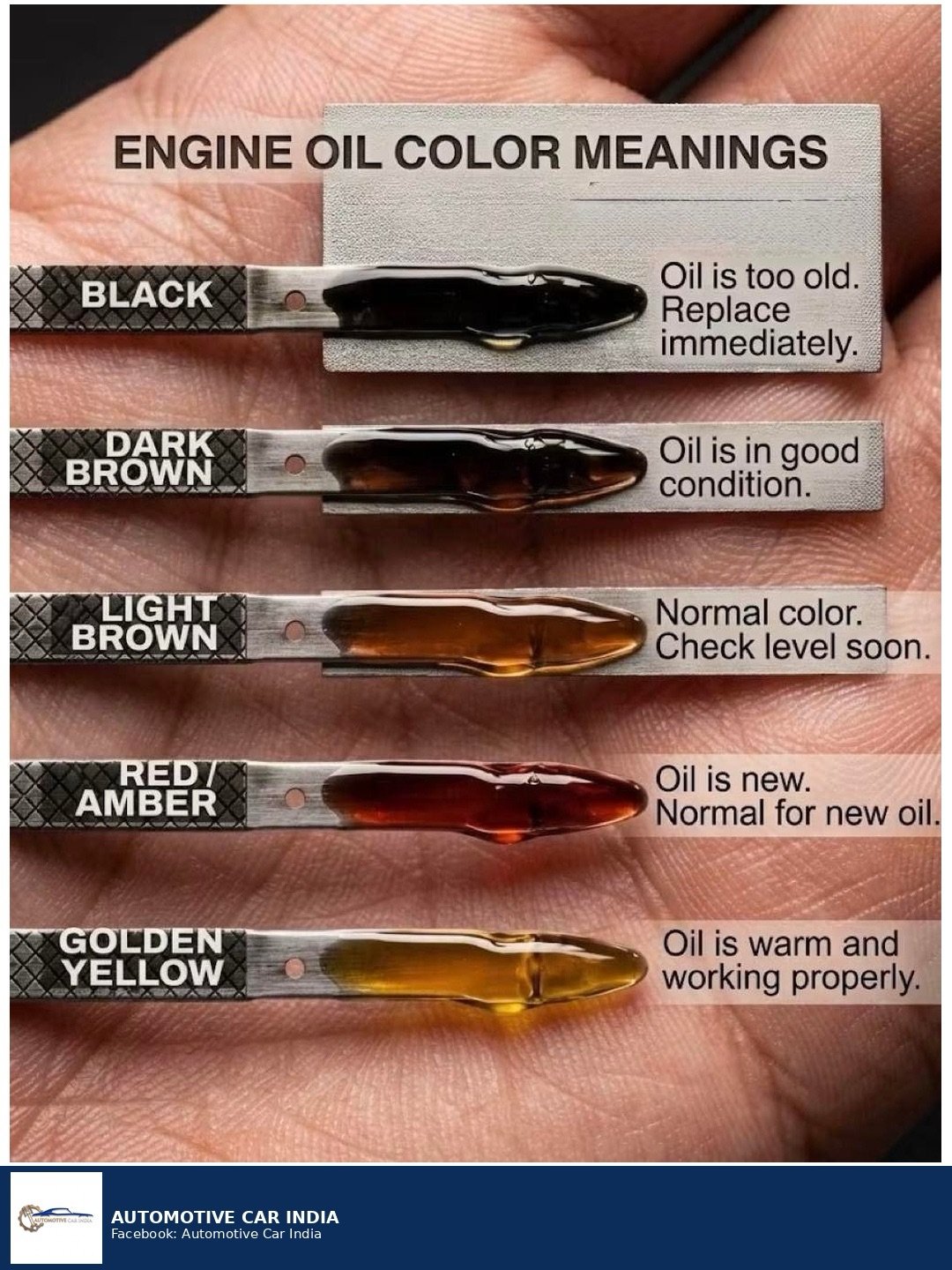
ENGINE OIL COLOR MEANINGS: Decoding Your Dipstick

Read Time:1 Minute, 38 Second
🛢️ 🚗
By Automotive Car India | Facebook: Automotive Car India
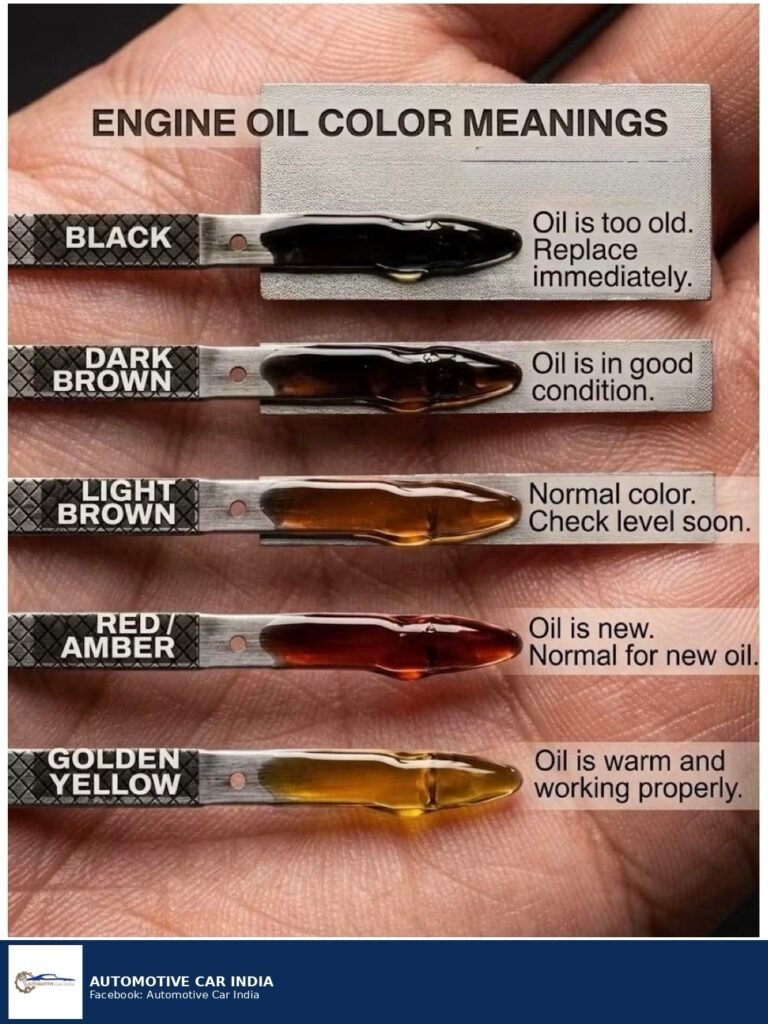
Engine oil color serves as a quick visual indicator of your oil’s operational health, thermal state, and ability to protect internal engine components from friction and harmful sludge buildup.
⚙️ ENGINE OIL COLOR INDICATORS & CONDITIONS:
🔹 BLACK: The oil is contaminated and too old. Replace the oil and filter immediately to protect internal engine bearings from severe wear.
🔹 DARK BROWN: The oil is in good condition and actively suspending micro-particles while lubricating internal engine surfaces.
🔹 LIGHT BROWN: Normal oil color indicating standard operation; check the fluid level on the dipstick soon.
🔹 RED / AMBER: Fresh, unused oil; this is the standard normal appearance for new engine oil right out of the bottle.
🔹 GOLDEN YELLOW: The oil is warm, circulating properly, and working correctly inside the engine.
🔧 COMMON DIAGNOSTICS & SOLUTIONS:
🚩 Issue 1: Oil Turning Pitch Black Rapidly After an Oil Change
Cause: Residual carbon soot and heavy sludge in the oil pan from previously delayed oil changes, or excessive combustion blow-by gases passing worn piston rings.
Solution: Perform a professional crankcase flush during the next service and adhere strictly to regular maintenance intervals.
🚩 Issue 2: Milky or Frothy Creamy Appearance on the Dipstick / Cap
Cause: Coolant mixing with the lubrication system due to a failed head gasket or a defective oil cooler core.
Solution: Shut off the engine immediately and tow the vehicle for repair to prevent total engine seizure.
🌟 PRO MECHANIC VALUE TIP:
Keep in mind that diesel engines behave differently than gasoline engines! In diesel applications, fresh oil typically turns black within just a few hundred miles of driving due to soot particles created during diesel combustion. This is completely normal and does not mean the oil has broken down. Always rely on factory mileage and time intervals alongside your visual dipstick checks!
When did you last check your oil? Comment your oil color below!
Follow us for daily car knowledge.
EngineOil #CarMaintenance #DipstickCheck #AutomotiveCarIndia #FacebookAutomotiveCarIndia

Happy
0 %

Sad
0 %

Excited
0 %

Sleepy
0 %

Angry
0 %

Surprise
0 %
 0
0
 0
0
More Stories
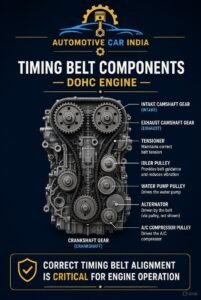
TIMING BELT COMPONENTS — DOHC ENGINE
The timing belt ensures precise valve timing by transferring rotation from the crankshaft to the camshafts—critical for engine performance. A damaged belt can lead to poor performance or severe damage, so always check tension and installation. This guide covers key components
ENGINE SENSORS & COMMON SYMPTOMS — KNOW THE SIGNS!
🚗🔧 A faulty sensor disrupts power, fuel efficiency, and drivability—MAF causes poor MPG, MAP leads to rough running, and CKP triggers hard starts. Don’t jump to replace sensors—first verify wiring, power, and signals. Discover which sensor caused your toughest issue today!
Which one has MORE negative camber — A or B?
👀 Same car. Two rear wheels. Which setup shows MORE negative camber — A or B? Active alignment checks reveal how top of the tire leans inward, using yellow reference lines for clarity. Curious mechanics: what causes excessive negative camber on a rear wheel?
HEAVY TRUCK AIR SUSPENSION — HOW IT WORKS
🚛💨 Heavy trucks rely on an air suspension system to keep ride height steady despite load shifts. Compressed air, valves, and linkages work together to support weight, absorb shocks, and control movement. This tech improves comfort, manages loads better,
Faulty VVT Solenoid? Know the Signs
🚗🔧 A faulty VVT solenoid disrupts engine timing, leading to loss of power, poor acceleration, and rough idling—don’t ignore the Check Engine Light! Check oil, wiring, and VVT components first before swapping parts.
BAD vs GOOD: HOW YOU SHUT DOWN YOUR CAR
🚗🔥 Turbocharged engines need a brief idle to stabilize after hard driving—avoid immediate shutdown to prevent overheating. Modern vehicles often manage cooling automatically, so consult your owner’s manual for the best approach. #CarTips
Average Rating