CLUTCH ASSEMBLY EXPLAINED — COMPONENTS | STRUCTURE | WORKING PRINCIPLE

Read Time:1 Minute, 8 Second
By Automotive Car India | Facebook: Automotive Car India
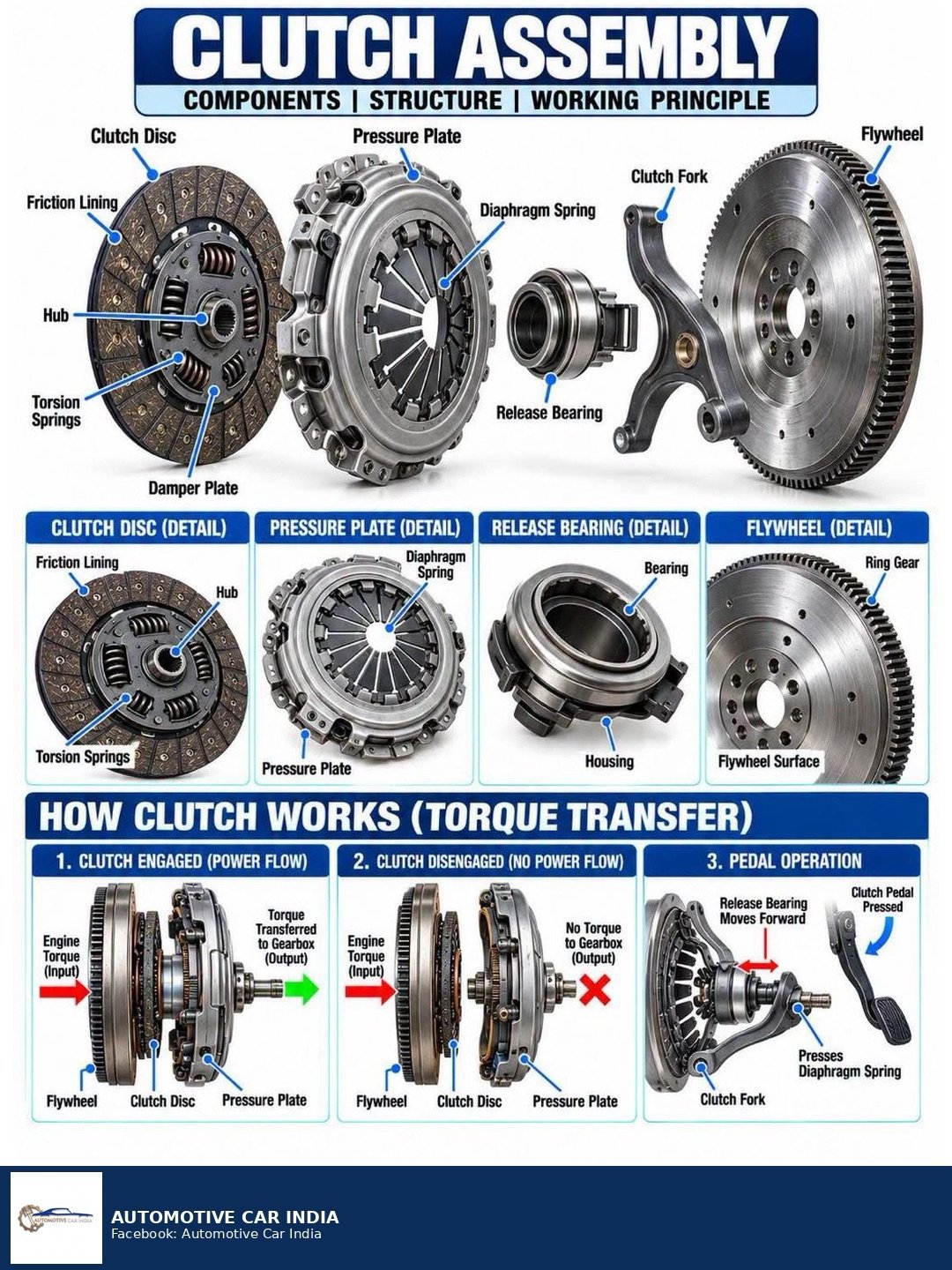
The clutch connects and disconnects engine power to the gearbox. Let’s break down each part!
🔧 MAIN COMPONENTS:
1️⃣ CLUTCH DISC
- Friction Lining: Grips flywheel, handles heat
- Hub: Splined centre connects to gearbox input shaft
- Torsion Springs: Absorb jerks, smooth engagement
- Damper Plate: Reduces vibrations
2️⃣ PRESSURE PLATE
- Diaphragm Spring: Provides clamping force – strongest part
- Pressure Plate body: Presses disc against flywheel
3️⃣ RELEASE BEARING
- Bearing: Allows spinning pressure plate to be pushed
- Housing: Mounts on clutch fork
4️⃣ FLYWHEEL
- Flywheel Surface: Smooth face for disc contact
- Ring Gear: Engages starter motor to crank engine
- Stores rotational energy
5️⃣ CLUTCH FORK
- Lever that pushes release bearing when you press pedal
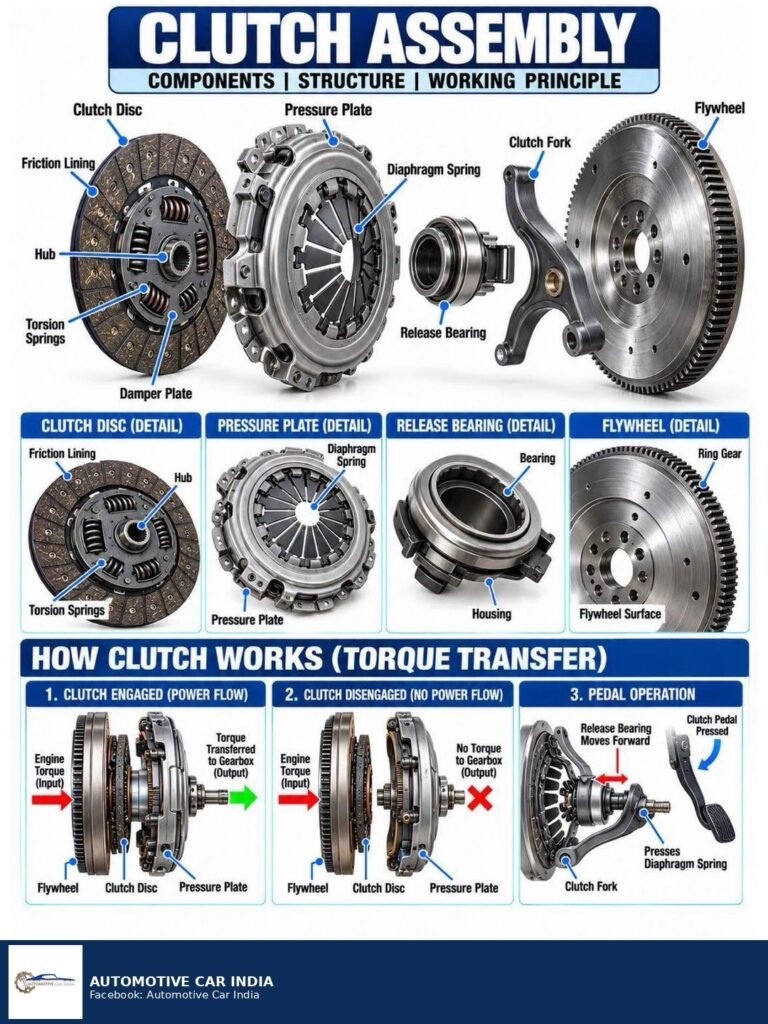
⚙️ HOW CLUTCH WORKS (TORQUE TRANSFER):
- CLUTCH ENGAGED (POWER FLOW) – Pedal released
Engine Torque (Input) → Flywheel → Clutch Disc clamped tightly → Pressure Plate → Torque Transferred to Gearbox (Output). Car moves! - CLUTCH DISENGAGED (NO POWER FLOW) – Pedal pressed
Flywheel still spinning, but Clutch Disc separated from Pressure Plate → No Torque to Gearbox (Output) → You can change gears! - PEDAL OPERATION
Clutch Pedal Pressed → Clutch Fork moves → Release Bearing Moves Forward → Presses Diaphragm Spring → Releases pressure on disc → Power disconnected.
PRO TIP: Don’t ride the clutch! Half-press burns friction lining fast. Fully press to shift, fully release to drive.
When did you last change your clutch? Comment your car & km!
ClutchAssembly #CarMechanic #ManualTransmission #AutomotiveCarIndia #FacebookAutomotiveCarIndia

Happy
0 %

Sad
0 %

Excited
0 %

Sleepy
0 %

Angry
0 %

Surprise
0 %
 0
0
 0
0
More Stories
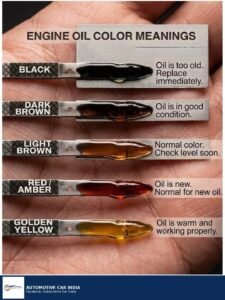
ENGINE OIL COLOR MEANINGS: Decoding Your Dipstick
Engine oil colour reveals engine health: dark brown signals good lubrication, while black indicates contamination requiring immediate replacement. Regular checks help prevent severe wear, especially with diesel engines where soot affects oil appearance. Stay proactive with maintenance to protect critical components.
TIMING BELT COMPONENTS — DOHC ENGINE
The timing belt ensures precise valve timing by transferring rotation from the crankshaft to the camshafts—critical for engine performance. A damaged belt can lead to poor performance or severe damage, so always check tension and installation. This guide covers key components
ENGINE SENSORS & COMMON SYMPTOMS — KNOW THE SIGNS!
🚗🔧 A faulty sensor disrupts power, fuel efficiency, and drivability—MAF causes poor MPG, MAP leads to rough running, and CKP triggers hard starts. Don’t jump to replace sensors—first verify wiring, power, and signals. Discover which sensor caused your toughest issue today!
Which one has MORE negative camber — A or B?
👀 Same car. Two rear wheels. Which setup shows MORE negative camber — A or B? Active alignment checks reveal how top of the tire leans inward, using yellow reference lines for clarity. Curious mechanics: what causes excessive negative camber on a rear wheel?
HEAVY TRUCK AIR SUSPENSION — HOW IT WORKS
🚛💨 Heavy trucks rely on an air suspension system to keep ride height steady despite load shifts. Compressed air, valves, and linkages work together to support weight, absorb shocks, and control movement. This tech improves comfort, manages loads better,
Faulty VVT Solenoid? Know the Signs
🚗🔧 A faulty VVT solenoid disrupts engine timing, leading to loss of power, poor acceleration, and rough idling—don’t ignore the Check Engine Light! Check oil, wiring, and VVT components first before swapping parts.
Average Rating